For most Miami trips, fly into MIA. Miami International Airport sits 8 miles from downtown and handles approximately 60 percent of Florida’s international arrivals. Excel Luxury Transportation serves both MIA and FLL with confirmed-rate private transfers, but the airport you choose affects your transfer cost, schedule margin and exposure to event-week surge pricing.
Key Takeaways
- MIA is 8 miles from downtown Miami; FLL is 30 miles north in Broward County
- A private car from MIA to South Beach runs $65–$95; from FLL the same trip costs $90–$140
- MIA handles approximately 60 percent of Florida’s international passenger traffic and serves more than 100 international cities
- FLL offers lower base fares on Spirit, Frontier, Southwest and Allegiant for select domestic routes
- During Art Basel, Ultra Music Festival and Miami Boat Show, rideshare surge pricing at both airports can double or triple standard fares — a pre-booked private transfer holds its confirmed rate
The Short Answer: MIA Wins for Most Miami Trips
If your destination is Miami Beach, Brickell, Wynwood, Coral Gables or downtown Miami, choose MIA. The drive is shorter, the international flight options are broader, and the ground transport infrastructure connects to Miami’s core faster than any route from Broward County.
FLL makes sense in three specific situations: when budget carrier fares on your route offer savings that exceed $100 per person over any MIA-serving airline, when your actual destination is in Broward County or northern Miami-Dade, or when your itinerary starts or ends at Port Everglades for a cruise.
The most common error travelers make is booking FLL because the headline airfare looks cheaper, then discovering the ground transport cost erases those savings. A $70 fare difference disappears when the car from FLL costs $50 more than the car from MIA — and that gap widens during event weekends when rideshare demand in Miami is high but the supply zone starts 30 miles from the hotel.
Corporate travelers face a sharper version of this problem. A 40-minute difference in transfer time is a real cost on an expense report, and a missed meeting because of I-95 congestion after a longer FLL drive is an unrecoverable one. The right airport for business travel is the one that gets you to the meeting reliably. For the majority of Miami business districts, that is MIA.
For leisure travelers with flexible schedules, FLL can offer genuine value on the right route. The framework is the same: airfare difference minus ground transport difference minus transfer time cost. Run the full calculation on your specific itinerary before deciding.
One factor that changes the calculation significantly is travel timing. If your arrival falls during Art Basel, Ultra Music Festival, the Miami International Boat Show or any major convention week, the rideshare variable from FLL swings dramatically — demand in Miami is high, but vehicles originating in Broward must cover 30 additional miles before reaching surge pricing territory. That combination produces the worst rideshare outcome: high surge, long drive. A pre-booked private car from either airport eliminates the surge variable, but the drive time from FLL remains. Budget an extra 30–40 minutes of buffer when arriving during event weeks and you have accounted for the main risk.
Side-by-Side Comparison: MIA vs FLL
Comparison Table
| Factor | MIA | FLL |
|---|---|---|
| Distance to Brickell | 8 miles | 30 miles |
| Distance to Miami Beach | 17 miles | 47 miles |
| Private car to Brickell | $65–$85 | $90–$120 |
| Private car to Miami Beach | $75–$95 | $110–$140 |
| Transfer time (no traffic) | 20–30 min | 40–55 min |
| Transfer time (peak hours) | 35–60 min | 65–95 min |
| International service | 60% of Florida international arrivals | Limited — Canada, Caribbean, Central America |
| Budget carriers | Limited | Spirit, Frontier, Southwest, Allegiant |
| Rail transit | MIA Mover + Metrorail to downtown | Brightline to Miami Central, Tri-Rail |
| Terminals and gates | 3 terminals, 6 concourses, 131 gates | 4 terminals |
| Annual passengers | ~52 million (projected 77M by 2040) | ~36 million |
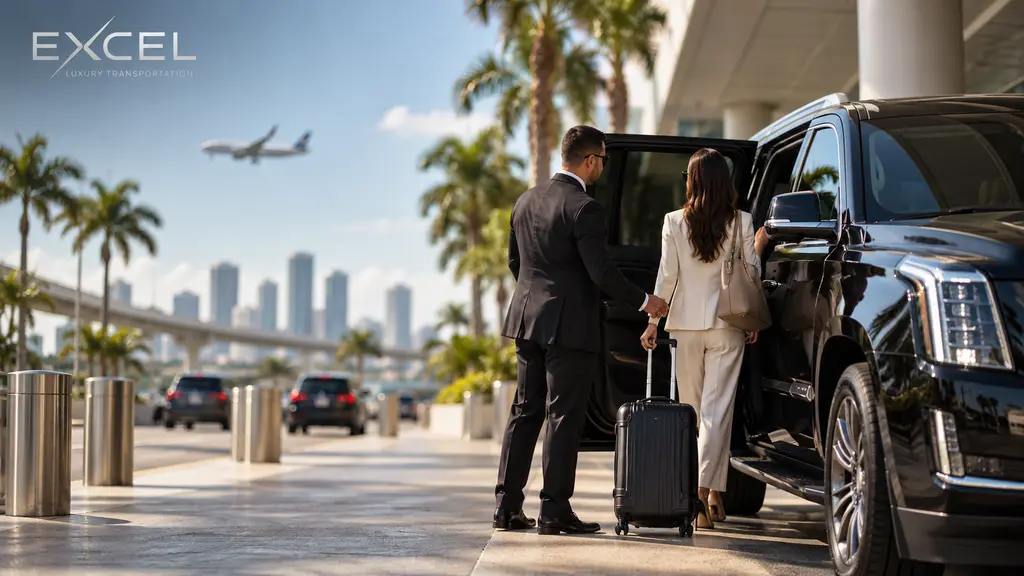
Cost
Ground transport is where the cost differential between these two airports becomes concrete and consequential. Most travelers focus on airfare and forget to add the transfer cost before completing the comparison. The honest calculation requires both numbers.
Option A — MIA
A private sedan from MIA to South Beach, Brickell or Wynwood runs $65–$95 depending on vehicle class, time of day and traffic conditions. For solo travelers or couples, a sedan is sufficient. Groups of three to six should book an SUV, which runs $85–$120 from MIA to central Miami destinations. Gratuity of 20 percent is standard and expected by licensed drivers. Tolls on the SR-836 Dolphin Expressway or the I-195 Julia Tuttle Causeway add $3–$7 to the fare depending on route.
Caveat
These fares reflect advance bookings with a licensed black car service operating under a Florida for-hire license. Rideshare from MIA under normal conditions runs $35–$65, but fares climb to $80–$130 during high-demand weekends including Art Basel in December, Ultra Music Festival in March and Miami Boat Show in February. A pre-booked private car holds its confirmed rate because the driver commits before the surge event begins.
Option B — FLL
A private sedan from FLL to Miami Beach runs $110–$140. To Brickell or downtown Miami, expect $90–$120. These fares reflect the additional 20–30 miles compared to MIA pickup. The Brightline train from Fort Lauderdale to Miami Central Station runs $19–$30 one way, but requires a car or taxi from the FLL terminal to the downtown Fort Lauderdale station — adding 15–20 minutes and $15–$25 — plus a final transfer from Miami Central to your hotel, which adds another car fare of $15–$35.
The total cost of a Brightline transfer from FLL to a Brickell hotel comes to approximately $55–$80, which is competitive with a direct rideshare but not consistently faster once all segments are added.
Time and Effort
Time is the harder cost to quantify but the one that matters most on a business trip. MIA to Brickell without traffic takes 20 minutes. The same trip from FLL takes 45–55 minutes on a clear day. During South Florida’s peak commute periods — inbound 7:00–9:30 AM and outbound 4:30–7:00 PM — those numbers extend to 35–60 minutes from MIA and 70–95 minutes from FLL.
For a traveler arriving Tuesday afternoon for a Wednesday morning meeting, the airport choice determines the margin available for dinner, preparation and sleep. The longer the drive, the more variables enter the equation: construction delays on I-95 between Broward and Miami-Dade, incidents at the I-595 interchange near Fort Lauderdale, drawbridge openings on Biscayne Bay causeways.
Pre-arranged private car services serving both airports monitor flights in real time and adjust pickup timing accordingly. That accounts for flight delays. It does not account for road conditions once the vehicle is on I-95 northbound from MIA or southbound from FLL.
Outcome and Risk
FLL introduces more variables into a Miami trip. More miles means more exposure to South Florida’s traffic patterns, which are among the most congested in the United States by commuter delay metrics. It also means a higher rideshare surge multiplier during event weekends, because the demand zone is centered on Miami but the supply origin is 30 miles north.
For a leisure traveler with a flexible schedule and a FLL fare that saves $150 per person, the risk is acceptable. For a corporate traveler with a confirmed meeting agenda and a travel policy requiring cost justification, it is an unnecessary risk that a one-line booking decision eliminates.
Miami International Airport in Depth
Terminals and Airlines at Miami International Airport
Miami International Airport operates three passenger terminals — North, Central and South — spread across six concourses labeled A through H, with a total of 131 gates. American Airlines occupies the North Terminal exclusively, which is one of the largest single-airline terminal complexes in the United States. American uses MIA as its primary hub for Latin American and Caribbean routes, with hundreds of daily departures across the region.
The Central and South terminals serve all other domestic and international carriers. British Airways, Lufthansa, Air France, LATAM, Avianca, Iberia, Copa Airlines, Turkish Airlines and Air Canada all operate from MIA. The airport functions as the dominant international gateway for Florida, processing approximately 60 percent of the state’s international passenger arrivals.
MIA’s current master plan projects growth to 77 million annual passengers by 2040, up from approximately 52 million in recent years. Capital improvements under the plan include international concourse expansion, additional gate capacity and infrastructure upgrades. Construction is ongoing throughout the campus, which can affect terminal navigation time and pickup zone locations — confirm your car service pickup zone when booking.
Ground Transportation from MIA
MIA’s ground transportation hub consolidates taxis, rideshare, hotel courtesy shuttles, rental car transfers and private car service pickups into organized zones on the lower level of each terminal. Licensed car services pick up in designated zones marked by signage. The facility is large, and first-time visitors should allow 10–15 minutes after clearing baggage to locate the correct pickup area.
Taxi fares from MIA are metered: to South Beach approximately $35–$50, to Brickell $25–$40, to Coral Gables $20–$30, to Coconut Grove $25–$35. Rideshare under normal conditions runs $5–$15 less than taxis on most routes. Both options are subject to surge pricing during high-demand periods.
Rental cars operate from a dedicated facility connected to the terminals via the MIA Mover automated train. The facility is efficient for travelers who plan to drive, but self-driving in Miami requires familiarity with South Florida road geography, and hotel parking costs in Miami Beach run $35–$55 per night at most properties.
MIA Mover and Metrorail Transit Connection
The MIA Mover is a free automated people mover connecting the main terminal complex to the Miami Intermodal Center, a transit hub located adjacent to the airport property. Journey time on the MIA Mover is approximately five minutes. From the Intermodal Center, the Miami Metrorail provides rail service southbound into downtown Miami in approximately 15 minutes, with stops at Coconut Grove, Brickell and Government Center.
The combined MIA Mover-to-Metrorail journey costs under $5 total and delivers a solo traveler with carry-on baggage to downtown Miami in 25–35 minutes from the terminal door, not counting the walk to the final hotel. For a traveler staying two blocks from a Metrorail station with one bag, this is the fastest and cheapest option available.
Airport Flyer Route 150, operated by Miami-Dade Transit, connects MIA to Miami Beach via Washington Avenue and Lincoln Road. The ride takes 40–55 minutes and costs $2.25. It is a practical option for budget-conscious travelers with minimal luggage and no time pressure.
Fort Lauderdale-Hollywood International Airport in Depth
Terminals and Airlines at Fort Lauderdale Airport
Fort Lauderdale-Hollywood International Airport operates four passenger terminals — 1, 2, 3 and 4 — in a compact, linear layout that most travelers find easier to navigate than MIA’s spread-out concourse structure. Baggage claim to terminal exit typically takes 15–20 minutes, slightly faster than MIA under comparable conditions.
Spirit Airlines accounts for a significant share of FLL’s domestic traffic and uses the airport as a major Florida hub. Southwest Airlines maintains a large FLL operation with frequency on high-demand domestic corridors. Frontier, Allegiant, JetBlue and Delta also serve FLL, though their MIA operations are comparably larger in total seat capacity.
The result is that FLL regularly offers lower base fares than MIA on domestic routes where Spirit, Frontier and Southwest compete on price. The fare gap on a specific route varies by origin city, booking window and travel date — it can be negligible or it can be $150 per person. The only way to know is to search both airports on your specific dates.
Ground Transportation from Fort Lauderdale Airport
FLL’s ground transportation operates from curbside zones outside each terminal, with rideshare pickup consolidated in a separate lot requiring a short walk. Taxis from FLL to Miami Beach run $75–$100 metered; to Brickell approximately $80–$110. Rideshare under normal conditions runs $55–$85, subject to the same event-week surge dynamics that affect MIA.
Pre-arranged private car services pick up in designated car service lanes outside each terminal. Confirming your exact pickup terminal and zone at the time of booking is recommended, as FLL’s multi-terminal layout requires the driver to be in the right location when you exit.
Parking at FLL is priced lower than MIA — garage rates begin around $22 per day versus $30 at MIA — a meaningful consideration for Florida residents who drive to the airport and return to their own vehicle.
Brightline Rail Connection from Fort Lauderdale
Brightline, the privately operated intercity rail service, connects Fort Lauderdale to Miami Central Station in approximately 30 minutes of train time on select frequencies. Fares run $19–$30 one way depending on booking timing and service class.
The Fort Lauderdale Brightline station is located in downtown Fort Lauderdale, approximately 2–3 miles from the FLL terminal. Getting from the airport to the station requires a taxi, rideshare or the Broward County Transit Bus Route 1, adding 15–25 minutes and a transfer cost of $10–$20. From Miami Central Station, reaching a Miami Beach or Brickell hotel requires a final rideshare or taxi transfer, adding another 15–25 minutes and $15–$30.
The full FLL-via-Brightline journey to a Brickell hotel takes 75–100 minutes from terminal exit to hotel check-in under favorable conditions. A direct private car transfer from FLL to the same hotel takes 50–75 minutes. For travelers with significant luggage or groups, the private car is simpler. For a solo business traveler with a laptop bag, Brightline can be competitive if the timing aligns.
Tri-Rail operates along the eastern South Florida corridor, with a station in Fort Lauderdale and connections to Miami Airport Station. Fares are $3.50–$7.75 one way. Service frequency is lower than Brightline and the stations are generally farther from Miami hotel clusters, but the fare is the lowest available option for FLL arrivals not using the Metrorail.
When MIA Is the Right Call
International Arrivals to Florida
If you are arriving internationally from Europe, Latin America, the Caribbean or any transatlantic or transpacific routing, MIA is almost certainly your arrival airport. The airport handles the dominant share of Florida’s international passenger volume and maintains direct service from more than 100 international cities. American Airlines, LATAM, British Airways, Lufthansa and their codeshare partners all use MIA as their Florida gateway.
FLL handles international arrivals from Canada, the Caribbean and select Central American destinations on carriers including WestJet, Sunwing and Copa. If your international routing lands at FLL, the decision was made by your airline’s network structure — the ground transport calculus above applies, but the airport selection was not yours to make.
Business Travel With a Schedule
For a corporate traveler with confirmed meetings, a pre-arranged Miami chauffeur from MIA is the operationally correct choice for nearly all Miami business district destinations. The driver monitors the flight, holds the confirmed rate, and the 20-minute drive from MIA to Brickell provides more schedule buffer than the 50-minute drive from FLL.
This matters when the meeting is at 9:00 AM the morning after arrival, when the connecting flight from another city landed late, or when the client’s calendar is fixed. The value of a shorter transfer is not the 30 minutes saved — it is the reduction in variables between landing and the first agenda item.
Corporate travel managers setting ground transport policy for Miami trips should default to MIA for any employee visiting Brickell, downtown Miami, Miami Beach or the Airport West corridor. A standing policy of MIA plus pre-booked private car produces predictable travel times, consistent expense reporting and a clear duty-of-care position. Exceptions for FLL — when a specific route has no MIA service or the fare difference is extraordinary — are easier to manage as documented exceptions than as a case-by-case decision left to individual travelers.
Group and Event Travel
Large groups traveling to Miami for corporate events, conferences or social occasions benefit from MIA’s proximity in a way that compounds per vehicle. A group of eight in a passenger van from MIA completes the transfer in 30 minutes. The same group from FLL takes 55–75 minutes. Across a four-day program with daily airport runs, the time difference is material.
For multi-vehicle event logistics — a conference with 40 arriving executives across three days — the difference in transfer time from MIA versus FLL affects the entire pickup schedule and the staffing cost of the ground transport operation.
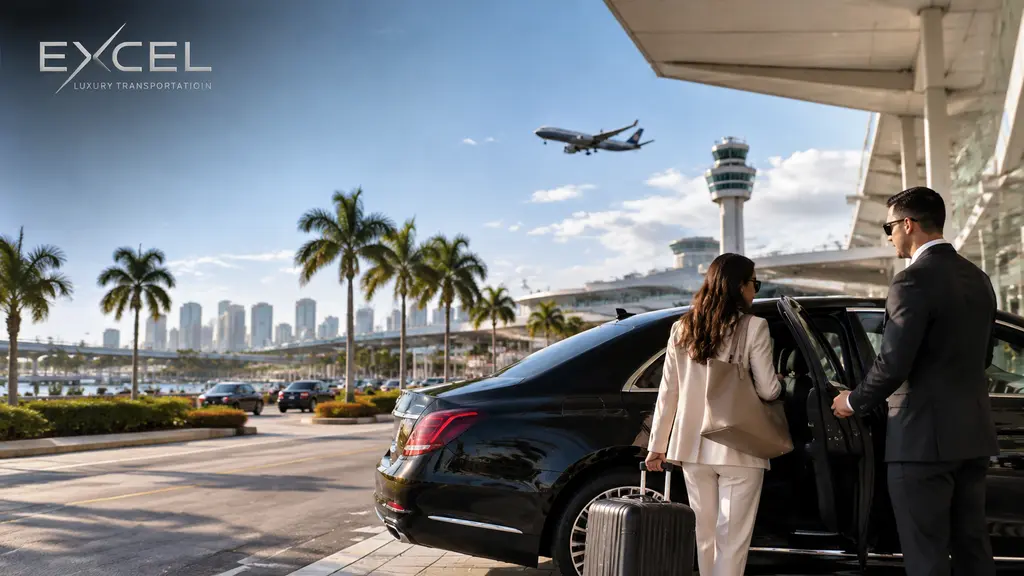
When FLL Is the Right Call
Budget Routes With Genuine Savings
If your origin city is served primarily by Spirit, Frontier or Southwest to FLL, and the fare difference versus any carrier to MIA exceeds $100 per person, the FLL savings are real. A family of four saving $80 per person in airfare nets positive even after the additional $40–$50 per person in ground transport.
The key phrase is “per person.” A solo traveler saving $90 in airfare but spending $50 more in ground transport nets $40. A couple in the same situation nets $80 total — still positive. The math changes at different group sizes, and it changes when a single private car fare is shared across multiple passengers.
Destinations in Broward County or Northern Miami-Dade
If your hotel or venue is in Fort Lauderdale, Hollywood, Hallandale Beach or Aventura, FLL is the geographically closer airport and the correct choice regardless of fare comparison. Aventura Mall, for instance, sits approximately equidistant from MIA and FLL — in that case, whichever airport has the better fare wins on simple math.
Sunny Isles Beach and Bal Harbour are close enough to FLL that the ground transport premium is minimal, making fare savings from FLL more impactful on those itineraries.
Cruise Passengers Departing Port Everglades
Port Everglades in Fort Lauderdale is one of the busiest cruise ports in the world. If your Miami trip concludes with or originates from a cruise departure at Port Everglades, FLL is the logical airport choice. The port is four miles from the terminal, a 10-minute drive without traffic. Flying into MIA and driving to Port Everglades adds 35–55 miles and 45–70 minutes to the pre-cruise logistics.
What Most People Get Wrong About MIA vs FLL Ground Transportation
The most widely repeated mistake is treating the airfare comparison as the complete analysis. Airfare is one line. Ground transport is a second line. Transfer time is a third, and it is the one most travelers undervalue until they are watching the airport express lane from a rideshare that just added a $40 surge charge.
The second common error is assuming rideshare prices are stable and predictable from either airport. They are not. During Art Basel in December, Ultra Music Festival in March, the Miami International Boat Show in February, and New Year’s weekend, rideshare surge pricing at both MIA and FLL can reach two to three times the standard rate. The demand originates in Miami. The supply routes from both airports. Pre-booked private car services from licensed providers hold their confirmed rate because the vehicle is committed before the event-week surge begins.
The third error involves insurance coverage, and it is one that most leisure travelers never consider — but every corporate travel manager writing a ground transport policy should understand. Rideshare vehicles operating as Transportation Network Companies carry insurance coverage that varies by phase of operation. When a driver has accepted a trip and is en route to pickup, coverage increases. When the driver has the app open but no accepted trip, minimum coverage in Florida can be as low as $50,000. Licensed livery operators serving as Miami black car services operate under Florida’s commercial for-hire licensing requirements and carry commercial auto insurance at higher minimums than TNC phase-one coverage. That difference is a duty-of-care consideration for any organization setting a corporate ground transport policy.
Most travelers booking a rideshare from MIA or FLL are unaware of this coverage gap. It does not affect the majority of uneventful transfers. It matters when something goes wrong — and insurance coverage is precisely the protection you cannot retroactively obtain.
A fourth error is underestimating how much the baggage claim and exit process differs between the two airports by time of day. MIA’s baggage claim during peak international arrival windows — typically early morning and early afternoon — can run 25–40 minutes from gate to bags, longer than the average domestic arrival. FLL’s more compact layout typically processes bags in 15–20 minutes. For a traveler booking a private car with a fixed pickup time, this difference matters: confirm your scheduled pickup time accounts for realistic baggage claim duration, not best-case timing. Most licensed car services that monitor flights also factor in historical baggage claim times for MIA versus FLL when scheduling pickup windows, which is one reason to book with a Miami-based operator who knows both airports rather than a national booking platform that generates generic pickup windows.
What We Recommend for Miami Passengers
For most Miami trips, fly into MIA and book a Miami airport transfer in advance. The shorter drive, the proximity to Miami Beach and Brickell, and the fixed-rate guarantee on pre-booked private cars make MIA the operationally correct default for a broad range of itineraries.
If you are flying FLL because your airline lands there or because the fare savings on your specific route are genuinely significant, the ground transfer decision is the same: book in advance with a licensed carrier rather than relying on rideshare during a trip that coincides with any Miami event. The 30-mile drive from FLL to Miami Beach is manageable with a confirmed private car and a driver tracking your flight. It is considerably less manageable in a rideshare during Art Basel week.
The MIA versus FLL comparison matters most on routes where both airports have active competing service. On those routes, the framework is straightforward: compare airfare, compare ground transport cost, compare transfer time and schedule margin. Run all three numbers on your specific dates before deciding. In most cases, the calculation points to MIA.
One additional consideration for repeat Miami travelers: if your trip includes Port Everglades cruise connectivity, Aventura meetings, or Broward County destinations on the same itinerary, a split-airport strategy can work — fly into FLL to save on airfare, then arrange a single ground transfer to Miami destinations with a driver who covers both counties. This preserves the fare savings while consolidating the transfer into one confirmed private booking rather than mixing rideshare segments. Excel Luxury Transportation covers both MIA and FLL to any Miami-Dade or Broward destination, so a single booking handles the full transfer regardless of which airport your airline uses.
FAQs
Is MIA or FLL closer when you prefer flying into Miami International Airport?
MIA is significantly closer to central Miami destinations. Miami International Airport is approximately 8 miles from Brickell and 17 miles from Miami Beach, with transfer times of 20–35 minutes in a private car under normal conditions. Fort Lauderdale-Hollywood International Airport is 30 miles from Brickell and 47 miles from Miami Beach, with transfers taking 45–75 minutes. For any destination in Miami proper, MIA delivers a materially shorter and more predictable transfer. Most travelers who prefer flying into an airport close to Miami should book MIA by default.
What is the ground transportation cost difference between MIA and FLL for a Miami trip?
A private sedan from MIA to South Beach costs $75–$95; the same trip from FLL runs $110–$140 — a difference of $35–$50 per booking. For a group sharing one vehicle, the per-person cost gap narrows. The gap widens during event-week surge pricing, when rideshare rates at FLL can climb $40–$80 higher than those at MIA. Pre-booked private transfers from both airports hold confirmed rates, which removes the surge pricing variable from the calculation entirely.
Does MIA handle more fort lauderdale international flights than FLL for South Florida arrivals?
MIA handles approximately 60 percent of Florida’s total international passenger arrivals and serves more than 100 international cities with direct service. Fort Lauderdale Airport handles international service primarily from Canada, the Caribbean and Central America on carriers including WestJet, Sunwing and Copa. For transatlantic and transpacific arrivals, MIA is the practical gateway for the region. Travelers arriving in South Florida from international origins almost always land at MIA rather than FLL.
What does the MIA master plan mean for ground transportation at Miami International Airport?
Miami International Airport’s long-range master plan projects growth from approximately 52 million annual passengers to 77 million by 2040. Infrastructure investment under the plan includes international concourse expansion, additional gate capacity and ground-side improvements. For current travelers, active construction affects terminal navigation and pickup zone locations. Confirming the specific pickup zone with your car service at booking time is recommended, as zone assignments shift during construction phases. The master plan signals long-term investment in MIA’s capacity as the region’s primary international airport.
About Excel Luxury Transportation
Excel Luxury Transportation is a licensed ground transportation company based in Miami, Florida. The company operates a fleet of sedans, SUVs and passenger vans serving Miami-Dade County, Broward County and the Palm Beaches. All vehicles carry commercial insurance and all drivers hold current state and local for-hire licensing.
Excel serves both Miami International Airport and Fort Lauderdale-Hollywood International Airport with confirmed-rate private transfers, real-time flight monitoring and drivers trained on South Florida’s road network.
View the full Fleet to match vehicle type to group size and itinerary.
Service Area
Excel Luxury Transportation serves pickup and dropoff locations across Miami-Dade County — including Miami Beach, Brickell, Coral Gables, Coconut Grove, Wynwood, the Design District, Key Biscayne and Aventura — and Broward County, including Fort Lauderdale, Hollywood and Hallandale Beach. Airport transfers from MIA and FLL to any destination in this service area are available with advance booking.
Next Step
Book your Miami airport transfer with Excel Luxury Transportation for a confirmed rate, professional driver and real-time flight monitoring. Reservations are available for arrivals and departures at both MIA and FLL. Reserve at least 24 hours ahead for standard service and 48 hours or more for groups, early morning departures and event-week travel.