Leave early enough to reach MIA before your airline’s recommended arrival time, allowing extra time for Miami rush-hour traffic and unexpected delays.This guide explains travelers driving during MIA peak traffic, Miami rush-hour patterns, airport arrival guidelines, traffic buffers, and practical ways to plan your departure time.
Key Takeaways
- Morning rush hour in Miami is from 6am to 9am & evening rush hour is from 4pm to 7pm.
- Morning rush hour is particularly important when traveling toward MIA.
- Miami’s evening traffic is generally more congested than its morning traffic.
- TomTom reported an average rush-hour speed of 27.4 km/h in Miami during 2025. (TomTom)
- A 10-kilometer trip took 19 minutes 56 seconds during morning rush hour.
- MIA recommends arriving two hours before domestic flights and three hours before international flights. (Miami International Airport)
- Traffic accidents, road backups, weather, and airport congestion can add unexpected delays.
- Build extra time into your journey rather than relying on the minimum travel estimate.
What Time Is Miami Rush Hour?
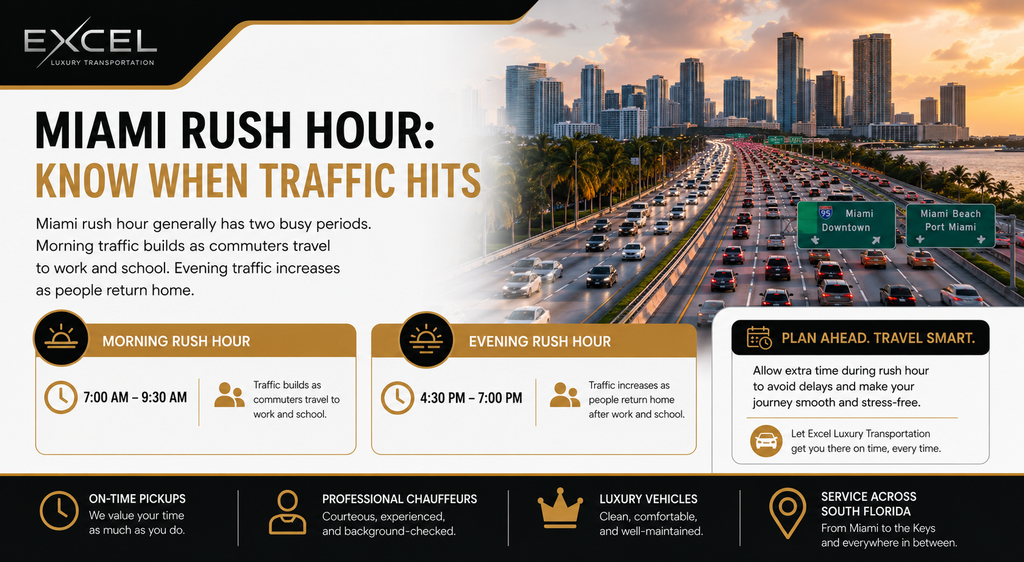
Miami rush hour generally has two busy periods. Morning traffic builds as commuters travel to work and school. Evening traffic increases as people return home.
TomTom’s 2025 Miami traffic data identifies separate morning and evening rush-hour periods. Morning rush-hour travel averaged 30.1 km/h. Evening rush-hour travel averaged 25.3 km/h. (TomTom)
This makes the evening period particularly important when planning a return journey across the city.
When Is Morning Rush Hour in Miami?
The morning rush hour is typically busiest during the early commuting period.
TomTom’s Miami data shows that an average 10-kilometer journey took 19 minutes 56 seconds during morning rush hour. Average congestion reached 65.4%, with average speed at 30.1 km/h. (TomTom)
For an MIA departure, this matters because a seemingly short trip can take considerably longer once congestion builds.
What Is Evening Rush Hour Like?
Miami’s evening rush hour can be even more difficult.
TomTom reported 86.3% average congestion during evening rush hour in 2025. Average speed dropped to 25.3 km/h, and a 10-kilometer journey took 23 minutes 43 seconds. (TomTom)
If your flight departs during this period, don’t plan your airport journey around the normal off-peak driving time.
When Does Peak Congestion Occur?
Peak congestion varies by road and day, so there is no single time that guarantees the worst traffic. Peak congestion hits hardest on I-95 and local causeways in Miami.
TomTom’s hourly data shows travel times rising during the morning and afternoon periods. Friday afternoon also showed longer travel times than several other weekdays in the 2025 data. (TomTom)
That means your departure time should consider the specific day, route, and flight.

How Early Should You Leave for MIA?
Start with the airport’s own recommended arrival time.
MIA recommends arriving at least two hours before a domestic flight and three hours before an international flight. It also advises travelers to allow time for transit or parking, airline check-in, baggage, and security. (Miami International Airport)
Your departure from home should therefore be:
Required airport arrival time + expected driving time + traffic buffer.
Don’t treat the driving estimate as the complete journey.
Example: Morning Domestic Flight
Suppose your domestic flight departs at 9:00 AM.
MIA recommends arriving at least two hours before departure. That means planning to be at the airport around 7:00 AM. (Miami International Airport)
If your route normally takes 30 minutes, leaving at 6:30 AM would leave very little room for a traffic accident or unexpected backup.
A better plan allows additional time for the Miami rush hour period.
Example: International Flight
For a 10:00 AM international flight, MIA recommends arriving at least three hours before departure. (Miami International Airport)
That puts your target airport arrival at approximately 7:00 AM.
If you’re traveling during the morning rush hour, your actual departure time should account for congestion rather than using a normal daytime driving estimate.
Don’t Forget the Airport Process
Driving to MIA is only one part of the journey.
You may need time for:
- Drop-off or parking
- Airline check-in
- Checked baggage
- Security screening
- Walking to your concourse
- Unexpected airport delays
MIA specifically advises travelers to allow time for transit or parking, baggage, check-in, and security. (Miami International Airport)
Traffic Accidents Can Change Everything
A traffic accident can quickly turn a manageable trip into a significant delay.
Historical traffic data can explain typical patterns. It cannot predict an accident on your specific route.
That is why your travel plan should include a buffer rather than relying on historical averages alone.
Check Traffic Before You Leave
Real-time traffic information can help you choose when to leave.
TomTom distinguishes between historical traffic patterns and live traffic information. Its live traffic data uses current traffic-flow information, while historical statistics are based on previous trip data. (TomTom)
Check your preferred navigation service shortly before departure. Look for congestion, road closures, accidents, and unusual backups.
Don’t Rely on a Single Map Estimate
A navigation map can provide a useful starting point, but the displayed travel time can change as traffic develops.
If the route is already congested, consider leaving earlier rather than hoping the traffic will clear.
This is especially important when your flight has a fixed departure time.
I-95 and Miami Traffic
I-95 is an important route through the Miami area, but it is not the only source of airport delays.
Your actual route to MIA may involve local roads, expressways, bridges, or other heavily traveled corridors.
The right departure time depends on your starting location, not simply your distance from the airport.
Give Yourself More Time on Weekdays
Weekdays generally involve more commuter traffic than weekends.
TomTom’s 2025 Miami data shows different travel patterns across the week, with afternoon travel times varying by day. (TomTom)
If you’re traveling on a weekday morning, assume that traffic conditions can be substantially different from a weekend journey.
Friday Afternoon Needs Extra Attention
Friday afternoon can be particularly challenging.
TomTom’s Miami data shows longer afternoon travel times on Friday than several other weekdays. (TomTom)
If your flight leaves MIA on Friday evening, avoid building your airport schedule around a normal midday journey.
What About a Traffic Backup?
If you see a significant backup before leaving, reassess your departure time.
The extra delay shown by your navigation service is not always the only consideration. Congestion can spread to alternative roads as drivers change routes.
Leaving earlier is often simpler than trying to find an unfamiliar shortcut under pressure.
Consider Your Starting Point
A traveler leaving from Downtown Miami has a different journey from someone departing from Miami Beach, Coral Gables, or farther north.
Don’t ask only, “How far is MIA?”
Ask:
“What will traffic look like between my address and MIA when I need to travel?”
That is a much more useful question.
Airport Drop-Off vs Parking
If someone is driving you to MIA, drop off can be simpler than parking.
MIA provides multiple transportation and access options for arriving passengers. (Miami Airport Newsroom)
If you’re driving yourself, add time for finding a parking facility, parking the vehicle, and reaching the terminal.
Why a Chauffeur Can Help
A professional chauffeur can take responsibility for the driving while you focus on your flight.
A chauffeur can also check traffic conditions before departure and adjust the route when necessary.
This can make airport travel more stress free, particularly during peak congestion.
Build the Buffer Around Your Flight
The most useful way to calculate your departure time is to work backward.
Flight departure → required airport arrival → airport processing → traffic journey → traffic buffer → leave home.
This approach is more reliable than simply adding 15 minutes to a navigation estimate.
What Does a Restful Web Service Have to Do With Traffic?
A restful web service is a technical way for software systems to exchange data through web-based APIs. It is not a traffic-planning method for passengers.
Traffic platforms can use APIs and live data feeds to provide information about road conditions, travel times, and locations. For travelers, the practical takeaway is simple: use a navigation service with current traffic data rather than relying only on historical averages.
What Is the Best Time to Leave?
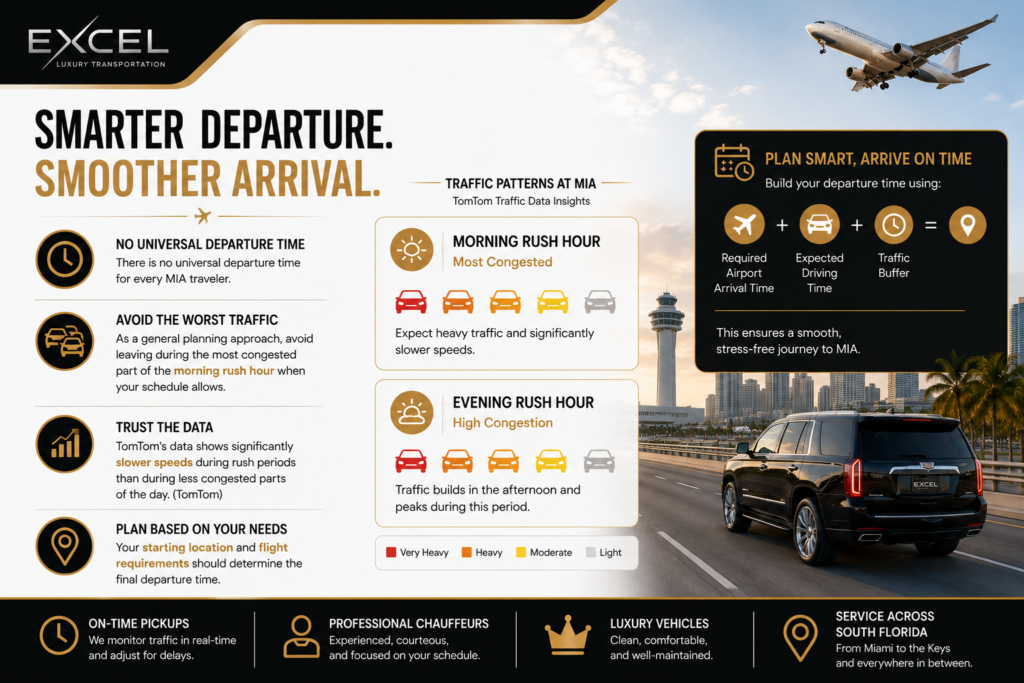
There is no universal departure time for every MIA traveler.
As a general planning approach, avoid leaving during the most congested part of the morning rush hour when your schedule allows.
TomTom’s data shows significantly slower speeds during rush periods than during less congested parts of the day. (TomTom)
Your starting location and flight requirements should determine the final departure time.
FAQs
How early should I leave during Miami rush hour?
During Miami rush hour, leave earlier than your normal driving estimate suggests. Start with MIA’s recommendation to arrive two hours before domestic flights or three hours before international flights. (Miami International Airport) Then add your expected driving time and a reasonable traffic buffer. Check live traffic before leaving, especially during weekday mornings.
What should I know about morning rush hour when driving to MIA?
The morning rush hour can significantly increase travel time. TomTom reported 65.4% average congestion and a 30.1 km/h average speed during Miami’s 2025 morning rush period. (TomTom) If your flight requires a morning airport arrival, work backward from the airport arrival target rather than relying on the usual travel time.
Can a restful web service provide Miami rush hour traffic data?
A restful web service can allow applications to retrieve traffic or location data through an API. However, travelers do not need to understand the technology to plan a trip. What matters is whether the navigation or traffic platform provides current information about congestion, accidents, road conditions, and travel time before you leave for MIA.
How much extra time should I allow for rush hour?
There is no fixed number that works for every route. Rush hour conditions change by road, weekday, weather, accidents, and traffic volume. TomTom’s 2025 Miami data shows a 10-kilometer trip taking 19 minutes 56 seconds during morning rush hour and 23 minutes 43 seconds during evening rush hour. (TomTom)
Is evening rush hour worse than morning rush hour in Miami?
Yes, based on TomTom’s 2025 data, evening rush hour was more congested than morning rush hour. Average congestion was 86.3% in the evening compared with 65.4% in the morning. Average speed was also lower in the evening. (TomTom) Travelers heading to MIA should therefore allow additional time for afternoon and evening airport journeys.
Plan Your MIA Departure
The safest approach is to plan backward from your required airport arrival time. Check current traffic, account for Miami rush hour, and leave enough room for unexpected delays.
MIA recommends two hours before domestic flights and three hours before international flights. (Miami International Airport) Traffic conditions then determine how early you should leave your starting point.
For travelers who prefer a professional airport transfer, Excel Luxury Transportation can coordinate your ride to MIA and help make the journey more comfortable.
Need a stress-free airport ride? Contact Excel Luxury Transportation at +1 786-706-4685 to arrange your MIA transfer.